
Dear passengers, please fasten your seatbelts. This is a Kaospilot flight, and we expect some turbulence on this four-day journey.
That's roughly how the announcement would have sounded if I had flown to Zurich for my Master Learning Archer certification. Instead, I arrived by train at Zurich main station to learn by Kaospilot how to design Learning Arches.
Learning Arches Design is a method for designing and visualizing learning journeys. A learning arch describes the course of a learning experience in three phases: Set, Hold and Land.
What I find most helpful is the visualization. It makes visible what each person and the group go through on the journey, much of which gets buried under words in a curriculum document. The method also consistently thinks in human terms, from the perspective of the group and the facilitation.
Set: Preparing for take-off
Before the sessions, we had a preparation task: to sketch out a first draft of a project using the Learning Arches. I had read Simon Kavanagh manual beforehand and attended the first part of the masterclass, which I wrote about here.
Start with landing is Simon's motto, and he asks two questions to go with it: Where are people coming from right now? And are they ready to open the arch? I arrived with a lot of theory from my reading and little feel for how to actually design with it.
Borrowing from Joseph Campbell's hero's journey, Simon calls the start of a learning journey the Call to Adventure. The facilitation invites the group on the journey and, at the end, secures a genuine commitment. As a storyteller, I had to smile, because in Campbell's structure the call is often followed by a refusal to answer it. Hello, empty arch template!
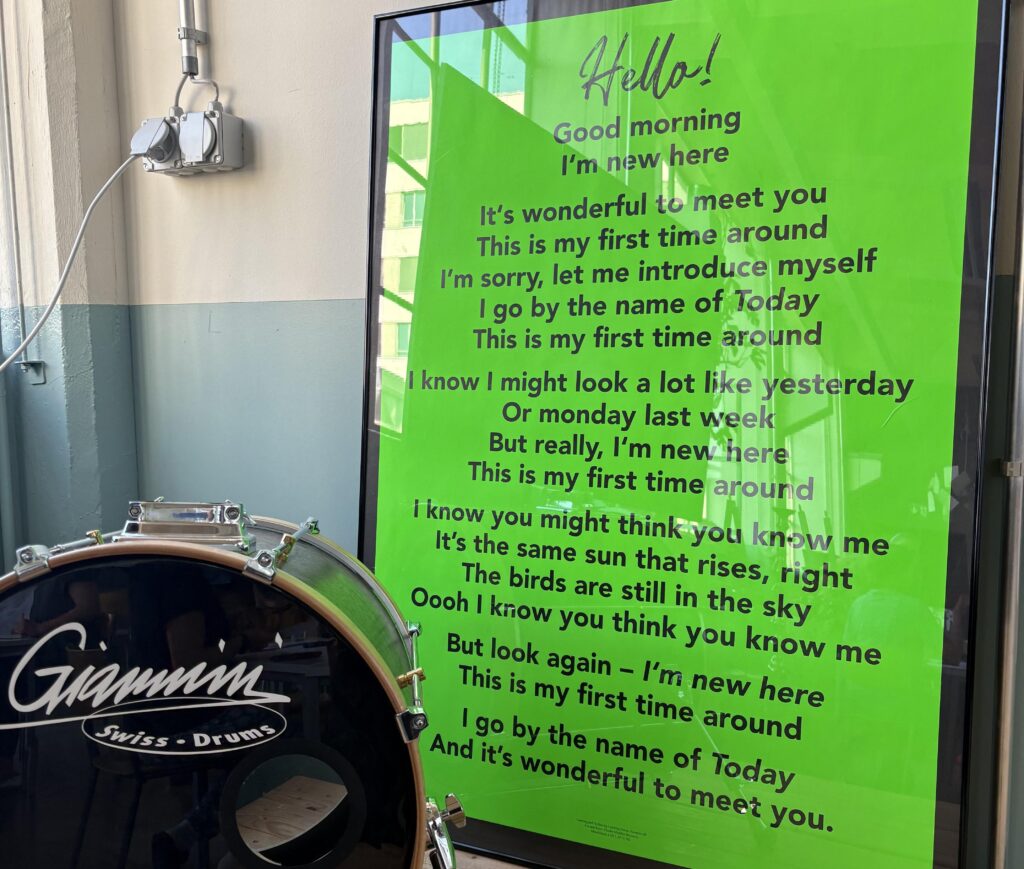
As in the first part, we started by arriving as a group and agreeing on a kind of contract for openness and respect. Kaospilot-style workshops are intense. They ask you to take part, open up and live with the fact that not everything is clear right away. For me, that meant stepping out of my comfort zone without crossing my own boundaries, since I was sitting in a room with people I was meeting for the first time. Even so, I have always come away with connections I'm glad to keep up, and it was tremendous fun.
Such an intense learning experience requires what Amy Edmondson calls psychological safety: the shared belief that in a group you can ask questions, raise concerns and admit mistakes. It has little to do with comfort, and nobody has to reveal everything about themselves for it. You can't promise psychological safety, but you can design conditions under which a group keeps negotiating it.
Hold: Turbulence
What helped me first was an arch on a topic I knew very well. That was when the structure first fell into place for me, because I already knew the content and could focus entirely on the form. With the empty project template, I had to do both at once.
I also learned a lot from a group task that didn't go well for us. The collaboration didn't really work, and we didn't reach a satisfying result. In the reflection, it became clear how differently we had approached the same task, and each of us still took something away. That the failure itself helped fits research on productive failure: people who first work on a problem on their own and then receive an explanation that makes different approaches visible often understand the concept more deeply.
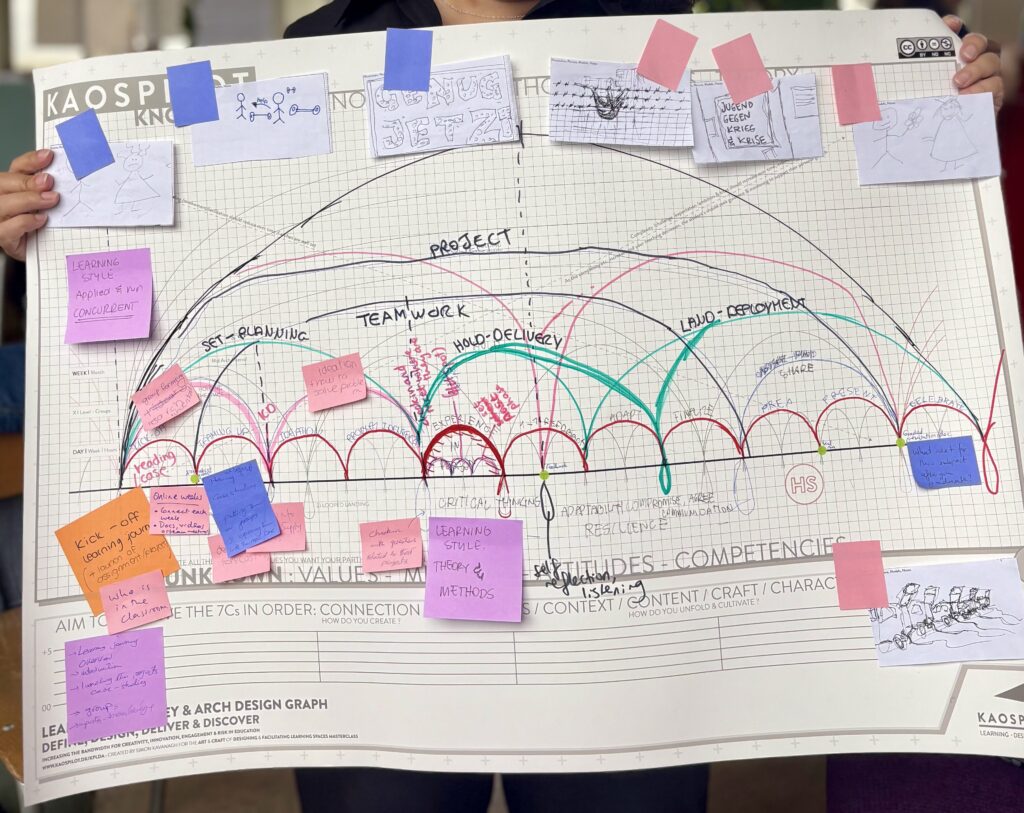
It finally clicked when I supported another participant in designing a first draft for her project. I understood what the individual components are for, because I had to use them for a concrete project and the group's questions made me justify my decisions. There was a productive, shared confusion about what belongs in which arch, and it took patience to sit with that uncertainty without resolving it too soon. Sitting with uncertainty doesn't mean letting a group drift, though. That's what planned pauses in the middle of an arch are for, where the facilitation checks in and changes course if needed.
Looking back, I went through the core learning sequence of the Learning Arches method myself: Act, Learn, Adapt, Repeat. Act means practicing first to see what people can already do. Learn delivers theory and methods in small doses. Adapt applies them straight away to a real project. Repeat starts the cycle again with the next exercise, building on what the group has learned so far.
That worked well for our group of experienced learning professionals. People who are new to a topic often learn better when the explanation comes first, as research on explicit instruction shows. Even then, experience has its place. In the masterclass, we heard that everything starts with a concrete experience that reveals a gap people then want to fill.
Without the failed group task and the confusion in the project, it wouldn't have clicked for me. The turbulence was part of it.
Land: Touchdown
At the end, our team canvas lay finished in front of us: a first, somewhat chaotic draft. And yet it was great to see the whole journey laid out visually. You could see how the energy flows through the journey, where we place moments of focus and where we deliberately leave room. For me, that was an important learning: arch design is iterative, both as a process and as a product.
In Learning Arches, landing means consciously closing an arch before the next one begins. Simon insists that you always land, because an arch that isn't landed carries open questions and frustration into the next one. As with our failed group task, it's the reflection afterwards that turns frustration into a learning moment.
That's why it pays to invest time in the landing, above all for reflection. I mean more than a summary of what was learned. The group looks at the process and at what it did to each person, what they want to take with them and how they can apply what they learned next. And finally: Are we all ready to move on, and if not, what do we need?
The biggest open question I'm taking with me is transfer into organizational contexts. Kaospilot is itself a participatory school where co-creation is a given. Many in my cohort work at universities with hierarchies and set topics, so they face a translation task similar to mine. In corporate learning and development, there's the added challenge that learning competes with day-to-day work. Trainings are often short, sometimes mandatory, and their goals are set by clients who aren't in the room. And people who sit in the room with their own manager are less likely to experiment openly.
On the other hand, I also see opportunities. The real cases are on the table, and what has been learned can be put into practice the next day in everyday work, as Act, Learn, Adapt, Repeat intends. The fact that people continue to work together afterwards is also an opportunity: A common learning culture can continue to thrive within a team if the environment supports it.
That is why I find really important to clarify early on with clients what a project is intended to achieve and what frames the group can contribute to. Co-creation begins with them and continues in the learning experience. A group can develop a culture of openness for a few days and then return to a daily routine that does not suit them. Whether the learned knowledge is applied depends heavily on the working environment, as transfer research shows. What can continue to live on from the shared learning culture within the team and who helps with this needs to be discussed and landed.
Still, even a two-hour workshop can be designed as an arch: a short arrival with the question of where people are coming from, a challenge based on a real case from their work, and a landing where the group clarifies what they'll try next.
My looped Landing
What am I taking from this journey into the next one? Above all, how well the Learning Arches method fits the question that drives me as a learning experience designer: What do people go through in a learning experience? The arches give me a bird's-eye view of the entire learning journey, from which I can zoom in at any time. I can share this perspective with clients. Before the first session takes place, we can see together where a learning journey needs room, where it might overwhelm people and where transfer into daily work begins. And the arches remind me that learning happens in loops.
If you are planning a learning journey right now and would like to look at it from a bird's-eye perspective, let's talk!
Photos: Teresa Moreno at Intrinsic, Zurich.
Edits in dialogue with Claude Opus 5.5 (Anthropic). Ideas and conclusions are mine.