The Mascot Trap
- Recognizable contexts
- Realistic constraints
- Specific roles
- Genuine dilemmas
- Intrinsic integration
The Science Behind Characters
Characters as Event Anchors
When Characters Become Noise
Characters work when the character’s specific context, constraints, and dilemmas are the learning content, not a wrapper around it.
The Self-Efficacy Factor
The character’s struggle does more than relatability; it’s the mechanism through which people build self-efficacy and mentally rehearse the learning without the ego-threat of direct failure.
⚠️ The Mirror Neuron Myth
From Research to Practice
- Is the character intrinsically integrated? Could we swap this character or story for a different one without changing what learners need to learn? If yes, it’s probably decoration. The character’s specific context should be inseparable from the learning objectives.
- Does the character enable active engagement? Research shows that learning increases from passive observation to active manipulation to constructive generation to interactive dialogue. “Interactive” means genuine dialogue or joint problem-solving with the character, not just clicking “Next” through their story.
- Is this a coping model or a mastery model? Does the character demonstrate the thinking process of overcoming realistic challenges, or do they just model perfect performance? The former supports self-efficacy.
- The outcome ist context-dependent (relationships, power dynamics, or competing values)
- Behavioral skills need to become concrete and observable
- People make decisions through or with the character (not just watch)
- The procedure is context-independent (same steps for everyone)
- The narrative could be swapped without changing what's learned
- The character would be more memorable than the learning objective
Mascot vs. Character
One Practice Example
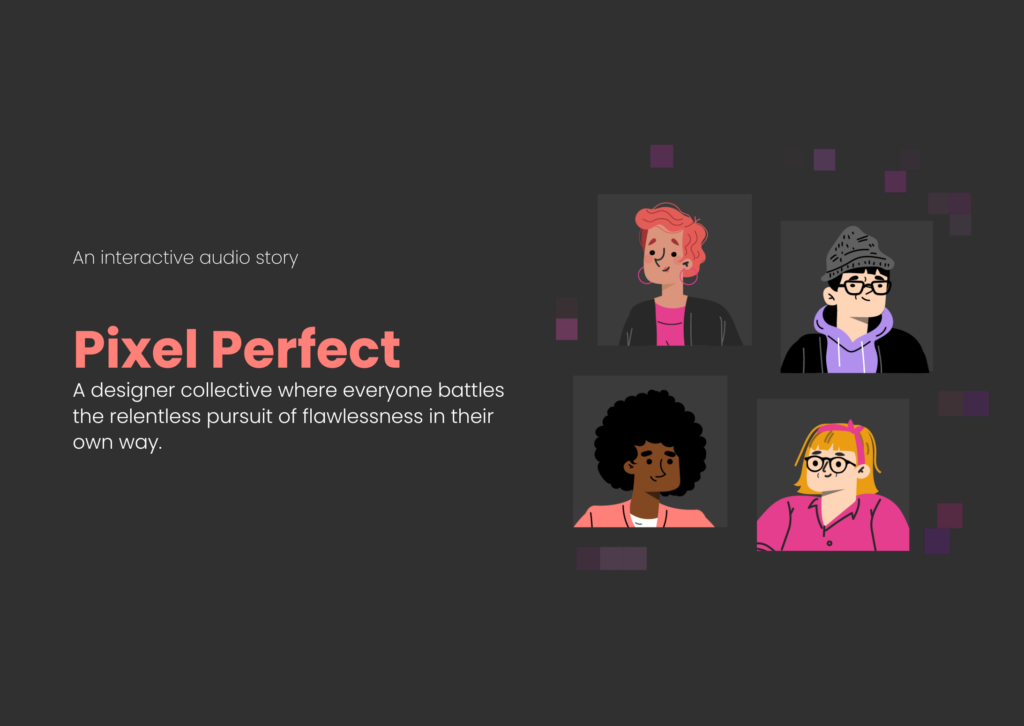
In Pixel Perfect, four characters navigate creative workplace dilemmas: Sol (artistic vision vs. practical constraints), Alex (client needs vs. creative integrity), Xavier (user experience vs. stakeholder expectations), Lotta (strategic thinking vs. team dynamics).
Creative professionals recognize them not as caricatures but as colleagues. Each faces decisions without obvious answers: compromise your vision or miss the deadline? Push back on client feedback or preserve the relationship?
What makes it work: specificity and intrinsic integration. Each character’s context is inseparable from the learning objectives, coping models struggling with the same tensions designers experience, not perfect exemplars demonstrating ideal behavior.
Making It Work
Starting small works: we can take one piece of existing learning content and ask “Who would actually face this challenge?” We can give them a role, a realistic situation, enough context that people understand the stakes.
Characters in learning design don’t need movie-like backstories. They need a recognizable problem intrinsically connected to what people need to learn. The swap question is the real test: could this character or story be replaced without changing what’s learned? If yes, it’s probably decoration.
Effective characters in learning do more than make content entertaining. Office Cinderella can be fun, but it won’t be really effective if it’s not intrinsically integrated in the learning goal. Characters make invisible thinking visible, abstract concepts concrete, and help learners construct richer mental models of complex situations.
The mascot trap is real. But so is the power of an authentic character with genuine constraints, facing decisions without obvious answers, showing not just what to do, but how to think through doing it.
Key Research: Situation models (Zwaan, Langston, & Graesser, 1995); Intrinsic vs extrinsic integration (Malone, 1981; Habgood & Ainsworth, 2005); Narrative for different knowledge levels (Tobler, Sinha, Köhler, & Kapur, 2024); Coping vs mastery models (Schunk, Hanson, & Cox, 1987); ICAP framework (Chi & Wylie, 2014); Pedagogical agents (Schroeder, Adesope, & Gilbert, 2013).