Character-Driven Learning Experiences

In a field that desperately needs evidence-based practice, we need to ask: when does a character actually improve a learning outcome, and when is it just cognitive noise?
When Characters Actually Serve Learning and When They’re Just Noise

The Mascot Trap

L&D is full of mascots, cartoons and generic “characters” with no real context beyond a name and a face. And now, there’s AI-generated narratives that force familiar story structures onto unrelated content: Hello, Office Cinderella! 
 
Don’t get me wrong. I actually love cartoons, comics, and illustrations. But, in a field that desperately needs more evidence-based practice, we need to ask: when does a character actually improve a learning outcome, and when is it just cognitive noise?

The main difference between helpful characters and annoying mascots is authenticity and purpose. Real characters have:

Authentic characters

The Science Behind Characters

Characters as Event Anchors

When we engage with information, we don’t just process the words; we construct a mental representation of the situation being described. This is called a situation model, and it’s one of the most robust findings in comprehension research.
 
According to research, readers track events along five dimensions: time, space, protagonist, causality, and intentionality. The protagonist dimension matters because characters serve as anchors for understanding. When the character changes, or when their goals shift, readers update their mental model of the situation.
 
This is why “Maya, a new team lead, receives critical feedback from a former peer” creates a different mental representation than “5 manager tips for feedback”. The character detail helps learners construct a richer, more specific situation model that includes relational dynamics, power shifts, and emotional stakes.The situation being modeled in the learner’s mind is more complex, which means the learning can address that complexity rather than oversimplifying it.

When Characters Become Noise

There’s a critical distinction between characters that are intrinsically integrated with learning content versus those that are extrinsically wrapped around it.
 
Research shows that intrinsic integration, where the character’s situation and the learning content are inseparable, produces better learning outcomes than extrinsic integration, where a story is layered on top of unrelated content.
 
Think about Office Cinderella: an AI-generated learning video that maps the Cinderella fairy tale onto workplace scenarios. The character might be relatable and the story familiar. But people have to process the Cinderella story structure, map fairy tale elements to office dynamics, and try to extract actual workplace skills. That’s additional cognitive load for minimal learning benefit. The Cinderella narrative could be swapped for any other story template without changing what learners need to learn. 

Characters work when the character’s specific context, constraints, and dilemmas are the learning content, not a wrapper around it.

The Self-Efficacy Factor

Not all characters are created equal, even when they’re intrinsically integrated. Social Cognitive Theory reveals a critical distinction: coping models versus mastery models.
 
A mastery model demonstrates perfect performance from the start. They know exactly what to do, execute flawlessly, and model ideal behavior. This is what most learning designers and SMEs default to: show the “right” way immediately.
 
A coping model struggles, verbalizes their thinking process, makes mistakes, and demonstrates the process of overcoming challenges. They eventually succeed, but only after working through realistic difficulties. When people see that, they believe the skill is achievable. When they see someone perform perfectly from the start, they assume the task is only for “experts” or people with innate talent.

The character’s struggle does more than relatability; it’s the mechanism through which people build self-efficacy and mentally rehearse the learning without the ego-threat of direct failure.

⚠️ The Mirror Neuron Myth

One of the most popular storytelling myths: we have special neurons that “fire” when we watch others, making us feel what they feel, which makes character-based learning especially powerful. This goes far beyond what the research supports. Mirror neurons were discovered in macaques performing motor tasks; their role in human empathy is still highly debated. Characters can activate perspective-taking and mental simulation, but not through a simple “mirror neuron” mechanism.

From Research to Practice

Before adding a character to learning content, we can ask ourselves three questions:

  1. Is the character intrinsically integrated? Could we swap this character or story for a different one without changing what learners need to learn? If yes, it’s probably decoration. The character’s specific context should be inseparable from the learning objectives.
  2. Does the character enable active engagement? Research shows that learning increases from passive observation to active manipulation to constructive generation to interactive dialogue. “Interactive” means genuine dialogue or joint problem-solving with the character, not just clicking “Next” through their story.
  3. Is this a coping model or a mastery model? Does the character demonstrate the thinking process of overcoming realistic challenges, or do they just model perfect performance? The former supports self-efficacy.

Use Characters When
Skip Characters When

Mascot vs. Character

🥸 Mascot version: Meet Feedback Fran! She’s a cheerful office worker who loves giving great feedback. Watch as Fran shows you the five steps to effective feedback. Remember: Feedback Fran says feedback should be timely, specific, and actionable!
 
🙂 Authentic character version: Maya was promoted three months ago and now manages her former peers. Today one submitted work that missed the mark. She has three conflicting thoughts: “This needs fixing,'” “I don’t want to seem power-hungry,” and “What if I’m wrong?” What should she say first?
 
👉 The difference: You could replace Fran with “Feedback Fred” or Clippy without changing the learning. You can’t swap Maya without losing the specific relational context that makes the dilemma meaningful.

One Practice Example

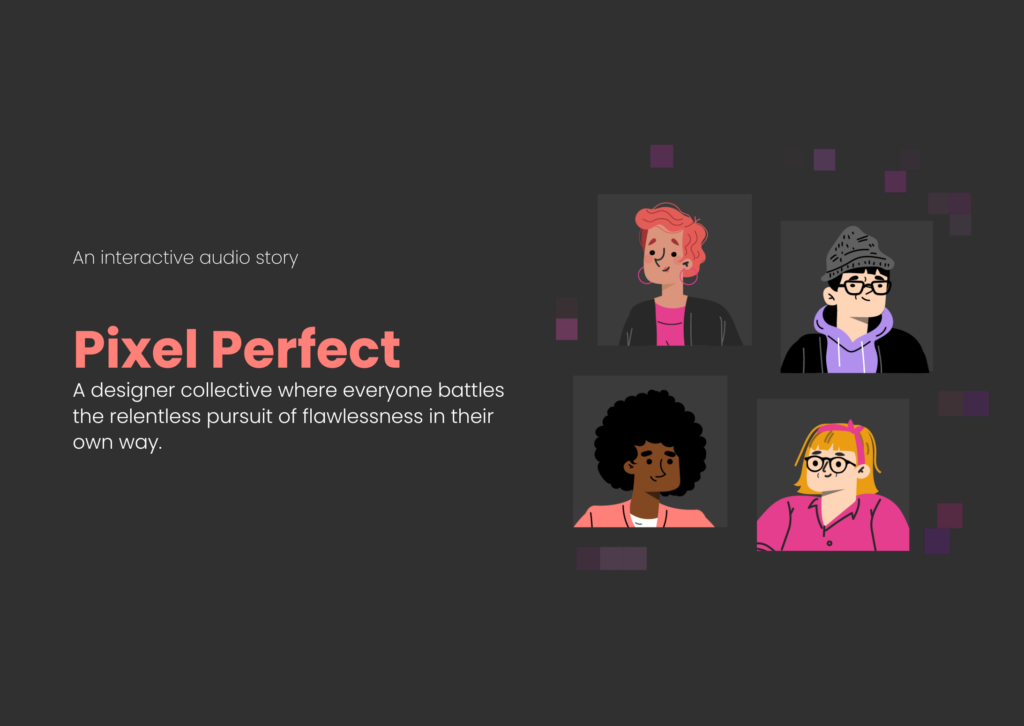
Cover of Pixel Perfect with four illustrated characters in a minimalist design on a dark background.

In Pixel Perfect, four characters navigate creative workplace dilemmas: Sol (artistic vision vs. practical constraints), Alex (client needs vs. creative integrity), Xavier (user experience vs. stakeholder expectations), Lotta (strategic thinking vs. team dynamics).

Creative professionals recognize them not as caricatures but as colleagues. Each faces decisions without obvious answers: compromise your vision or miss the deadline? Push back on client feedback or preserve the relationship?

What makes it work: specificity and intrinsic integration. Each character’s context is inseparable from the learning objectives, coping models struggling with the same tensions designers experience, not perfect exemplars demonstrating ideal behavior.

Making It Work

Starting small works: we can take one piece of existing learning content and ask “Who would actually face this challenge?” We can give them a role, a realistic situation, enough context that people understand the stakes.

Characters in learning design don’t need movie-like backstories. They need a recognizable problem intrinsically connected to what people need to learn. The swap question is the real test: could this character or story be replaced without changing what’s learned? If yes, it’s probably decoration.

Effective characters in learning do more than make content entertaining. Office Cinderella can be fun, but it won’t be really effective if it’s not intrinsically integrated in the learning goal. Characters make invisible thinking visible, abstract concepts concrete, and help learners construct richer mental models of complex situations.

The mascot trap is real. But so is the power of an authentic character with genuine constraints, facing decisions without obvious answers, showing not just what to do, but how to think through doing it.

Key Research: Situation models (Zwaan, Langston, & Graesser, 1995); Intrinsic vs extrinsic integration (Malone, 1981; Habgood & Ainsworth, 2005); Narrative for different knowledge levels (Tobler, Sinha, Köhler, & Kapur, 2024); Coping vs mastery models (Schunk, Hanson, & Cox, 1987); ICAP framework (Chi & Wylie, 2014); Pedagogical agents (Schroeder, Adesope, & Gilbert, 2013).


Share the Post:

Related Posts

LXD

Why You Need Big Ideas

When learning initiatives fail to resonate, they often lack an emotional core: the Big Idea that connects business goals to individual motivation. It’s the core insight you want your audience to feel and remember.

Read More »

BLOG SUBSCRIPTION

Want learning design insights straight to your inbox?

I send 1–2 thoughtful emails per month — no noise.

By clicking "Sign me up", you agree that your email address will be stored and used to send you the newsletter.
I won't spam you! You can unsubscribe any time. Read our privacy policy for more info.